OpenPyXL 3.0.7
  • 教程
  • 简单用法
  • 性能
  • 优化模式
  • 插入和删除行和列,移动单元格范围
  • 操纵 Pandas 和 NumPy
  • 图表
  • 注释
  • 操控样式
  • 额外工作表特性
  • 条件格式化
  • 数据透视表
  • 打印设置
  • 使用过滤器和排序
  • 验证单元格
  • 定义名称
  • 工作表表格
  • 剖析公式
  • 日期和时间
  • 保护
  • 开发
  • openpyxl 包
  • 3.0.7 (2021-03-09)
  • 3.0.6 (2021-01-14)
  • 3.0.5 (2020-08-21)
  • 3.0.4 (2020-06-24)
  • 3.0.3 (2020-01-20)
  • 3.0.2 (2019-11-25)
  • 3.0.1 (2019-11-14)
  • 3.0.0 (2019-09-25)
  • 2.6.4 (2019-09-25)
  • 2.6.3 (2019-08-19)
  • 2.6.2 (2019-03-29)
  • 2.6.1 (2019-03-04)
  • 2.6.0 (2019-02-06)
  • 2.6.-b1 (2019-01-08)
  • 2.6-a1 (2018-11-21)
  • 2.5.14 (2019-01-23)
  • 2.5.13 (brown bag)
  • 2.5.12 (2018-11-29)
  • 2.5.11 (2018-11-21)
  • 2.5.10 (2018-11-13)
  • 2.5.9 (2018-10-19)
  • 2.5.8 (2018-09-25)
  • 2.5.7 (2018-09-13)
  • 2.5.6 (2018-08-30)
  • 2.5.5 (2018-08-04)
  • 2.5.4 (2018-06-07)
  • 2.5.3 (2018-04-18)
  • 2.5.2 (2018-04-06)
  • 2.5.1 (2018-03-12)
  • 2.5.0 (2018-01-24)
  • 2.5.0-b2 (2018-01-19)
  • 2.5.0-b1 (2017-10-19)
  • 2.5.0-a3 (2017-08-14)
  • 2.5.0-a2 (2017-06-25)
  • 2.5.0-a1 (2017-05-30)
  • 2.4.11 (2018-01-24)
  • 2.4.10 (2018-01-19)
  • 2.4.9 (2017-10-19)
  • 2.4.8 (2017-05-30)
  • 2.4.7 (2017-04-24)
  • 2.4.6 (2017-04-14)
  • 2.4.5 (2017-03-07)
  • 2.4.4 (2017-02-23)
  • 2.4.3 (未发行)
  • 2.4.2 (2017-01-31)
  • 2.4.1 (2016-11-23)
  • 2.4.0 (2016-09-15)
  • 2.4.0-b1 (2016-06-08)
  • 2.4.0-a1 (2016-04-11)
  • 2.3.5 (2016-04-11)
  • 2.3.4 (2016-03-16)
  • 2.3.3 (2016-01-18)
  • 2.3.2 (2015-12-07)
  • 2.3.1 (2015-11-20)
  • 2.3.0 (2015-10-20)
  • 2.3.0-b2 (2015-09-04)
  • 2.3.0-b1 (2015-06-29)
  • 2.2.6 (未发行)
  • 2.2.5 (2015-06-29)
  • 2.2.4 (2015-06-17)
  • 2.2.3 (2015-05-26)
  • 2.2.2 (2015-04-28)
  • 2.2.1 (2015-03-31)
  • 2.2.0 (2015-03-11)
  • 2.2.0-b1 (2015-02-18)
  • 2.1.5 (2015-02-18)
  • 2.1.4 (2014-12-16)
  • 2.1.3 (2014-12-09)
  • 2.1.2 (2014-10-23)
  • 2.1.1 (2014-10-08)
  • 2.1.0 (2014-09-21)
  • 2.0.5 (2014-08-08)
  • 2.0.4 (2014-06-25)
  • 2.0.3 (2014-05-22)
  • 2.0.2 (2014-05-13)
  • 2.0.1 (2014-05-13) brown bag
  • 2.0.0 (2014-05-13) brown bag
  • 1.8.6 (2014-05-05)
  • 1.8.5 (2014-03-25)
  • 1.8.4 (2014-02-25)
  • 1.8.3 (2014-02-09)
  • 1.8.2 (2014-01-17)
  • 1.8.1 (2014-01-14)
  • 1.8.0 (2014-01-08)
  • 1.7.0 (2013-10-31)
  • Gauge Charts

    Gauge charts combine a pie chart and a doughnut chart to create a “gauge”. The first chart is a doughnut chart with four slices. The first three slices correspond to the colours of the gauge; the fourth slice, which is half of the doughnut, is made invisible.

    A pie chart containing three slices is added. The first and third slice are invisible so that the second slice can act as the needle on the gauge.

    The effects are done using the graphical properties of individual data points in a data series.

    from openpyxl import Workbook
    from openpyxl.chart import PieChart, DoughnutChart, Series, Reference
    from openpyxl.chart.series import DataPoint
    data = [
        ["Donut", "Pie"],
        [25, 75],
        [50, 1],
        [25, 124],
        [100],
    ]
    # based on http://www.excel-easy.com/examples/gauge-chart.html
    wb = Workbook()
    ws = wb.active
    for row in data:
        ws.append(row)
    # First chart is a doughnut chart
    c1 = DoughnutChart(firstSliceAng=270, holeSize=50)
    c1.title = "Code coverage"
    c1.legend = None
    ref = Reference(ws, min_col=1, min_row=2, max_row=5)
    s1 = Series(ref, title_from_data=False)
    slices = [DataPoint(idx=i) for i in range(4)]
    slices[0].graphicalProperties.solidFill = "FF3300" # red
    slices[1].graphicalProperties.solidFill = "FCF305" # yellow
    slices[2].graphicalProperties.solidFill = "1FB714" # green
    slices[3].graphicalProperties.noFill = True # invisible
    s1.data_points = slices
    c1.series = [s1]
    # Second chart is a pie chart
    c2 = PieChart(firstSliceAng=270)
    c2.legend = None
    ref = Reference(ws, min_col=2, min_row=2, max_col=2, max_row=4)
    s2 = Series(ref, title_from_data=False)
    slices = [DataPoint(idx=i) for i in range(3)]
    slices[0].graphicalProperties.noFill = True # invisible
    slices[1].graphicalProperties.solidFill = "000000" # black needle
    slices[2].graphicalProperties.noFill = True # invisible
    s2.data_points = slices
    c2.series = [s2]
    c1 += c2 # combine charts
    ws.add_chart(c1, "D1")
    wb.save("gauge.xlsx")
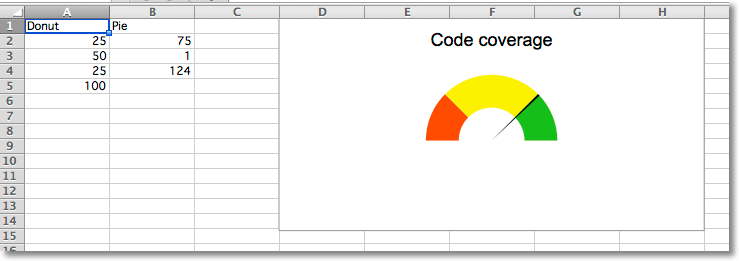
    					
    "Sample gauge chart"
